Get In Touch


Social Links




Welcome to the Blok Blok Studio blog — where we share ideas, insights, and strategies to help you grow, create, and innovate. Whether you’re looking for practical tips, industry trends, or fresh perspectives, you’ll find resources here to inspire your next move.
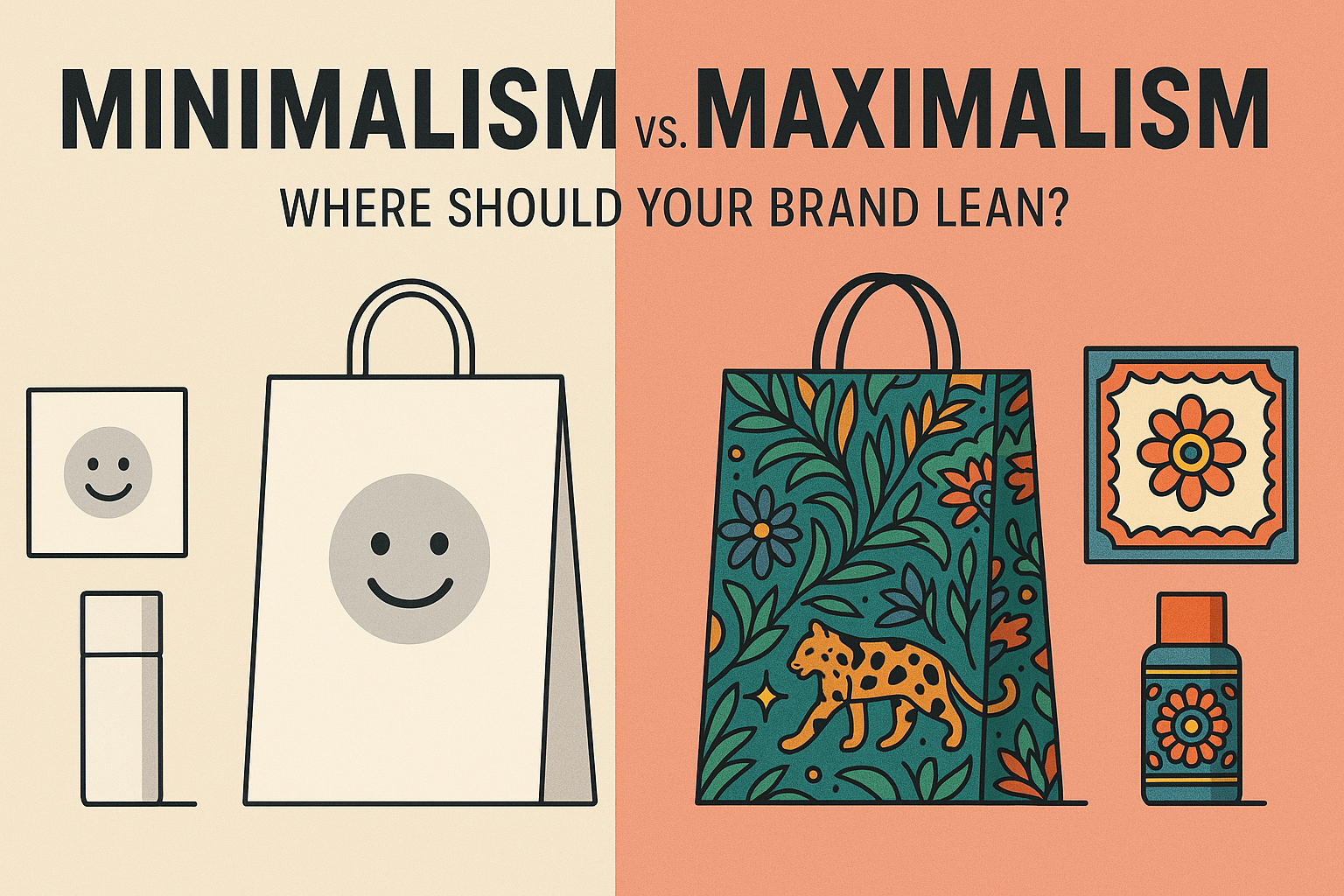
Minimalism is quiet. Maximalism is loud. Minimalism whispers with white space. Maximalism shouts in neon. Both are flirting with your brand, and both are convinced they’re The One.
So, who do you take home?
This isn’t just a design debate. It’s a cultural one. We live in a time where people fall asleep to ten-hour “lofi beats to relax/study to” loops while also bingeing TikToks cut like fever dreams, flashing capybaras, SpongeBob memes, and Jersey club edits at seizure speed. Calm and chaos coexist in the same feed. Which means the branding battlefield has never been messier… or more exciting.
Before you call your designer and demand Helvetica Neue or a Lisa Frank moodboard, it’s worth remembering: choosing between minimalism and maximalism isn’t really about taste. It’s about alignment. With your audience. With your promise. With the cultural current you want to surf.
Minimalism, at its core, is about stripping design down to its bones: clean lines, tight palettes, clarity above all else. Think Apple keynote slides. Muji’s unbranded notebooks. Balenciaga’s normcore deadpan when they send a model down the runway in what looks like a literal Ikea bag. Minimalism is about control, about saying: “We’ve edited out the noise. What remains is essential.” Its best qualities are timelessness, chic restraint, and calm confidence. But it can also turn sterile or elitist, and in a world where many brands reach for it by default, minimalism risks blurring into the wallpaper.
Maximalism is the opposite impulse: pile it on, layer it up, and make sure nobody mistakes you for boring. It’s Gucci’s Alessandro Michele-era baroque fever dream, or the chaotic joy of TikTok “cores”—cottagecore, clowncore, blokecore, goblincore—where every inch of space is filled with personality. It’s Spotify Wrapped turning data into confetti and sparking FOMO worldwide. Maximalism is joy, chaos, cultural overflow. When it works, it feels alive, original, unforgettable. When it doesn’t, it tips into overload, fatigue, or the dreaded “doing too much.”
So how do you decide? Forget trends for a second, and forget what looks good on a pitch deck at two in the morning. The real question is what’s true to your brand. Start with your audience. Minimalism resonates with people who crave order, calm, and sophistication; they want a brand that feels like sanctuary from the chaos of their For You page. Maximalism, on the other hand, speaks to people who want stimulation, personality, and excess—people for whom abundance equals authenticity, who want a brand that feels like scrolling Tumblr in 2013, when every new post was another hit of serotonin.
Next, think about your brand’s core promise. If what you’re really selling is clarity, precision, wellness, innovation, or sophistication, minimalism is your sharpest tool. If what you’re promising is joy, community, rebellion, culture, or abundance, maximalism is the better fit. Form follows function. If your story is serenity, your visuals can’t scream. If your story is riotous fun, your branding can’t whisper.
And then there’s context. Minimalist brands tend to thrive in tech, wellness, luxury, and design-led industries—spaces where calm signals credibility. Think Oura rings, Aesop’s apothecary chic, or Apple’s temple-like stores. Maximalist brands thrive in fashion, entertainment, nightlife, and youth culture—categories where spectacle is the point. Supreme literally sold out bricks. Netflix designs key art that practically shouts at you. These are brands that win by leaning into the noise. But sometimes the smartest move is to zag. If your whole industry is beige minimalism, maximalism can make you unforgettable. If your space is drowning in maximalist noise, a crisp minimal identity can slice through like silence at a rave.
The case studies are telling. Minimalism gave us Apple, whose bitten apple in monochrome is one of the most recognizable marks on the planet. It gave us Glossier, whose whisper-pink branding created a secret club aura, like you had to be in the know to even find it. Maximalism gave us Gucci’s Renaissance chaos, Netflix’s visual overload, and every Y2K-nostalgia brand that looks like it fell out of a Bratz doll’s purse. It’s also meme culture itself—layered, self-aware, always one step from absurdity. And then there are the hybrids. Nike’s swoosh is as minimal as it gets, but its campaigns are maximalist storytelling explosions. That’s the sweet spot: knowing when to whisper and when to scream.
Of course, everyone wants me to declare a winner, to say “minimalism is dead” or “maximalism is the future.” But the truth is less sexy and more useful. If your audience leans toward structure, if your story is about clarity, if your category is noisy, then minimalism is your sharpest weapon. If your audience leans toward expression, if your story is about abundance, if your category is sterile, then maximalism is your edge. And remember: branding isn’t religion. You don’t have to swear allegiance. Some of the most exciting brands today use both modes, building minimalist systems at their core—logos, typography, websites—then unleashing maximalist chaos in campaigns, events, and social drops. It’s the same logic as a DJ set: you keep a steady rhythm, but you know when to hit the crowd with ambient stillness or hard techno spikes.
Minimalism versus maximalism, in the end, isn’t about picking sides. It’s about identity. It’s about knowing what you’re promising and how your people want to receive it. Once you nail that, the design almost chooses itself. The better question isn’t “Which is cooler right now?” but “Which is truer to us?” Because in branding, as in life, the style only works if it matches the soul. And whether you’re whispering like Muji or screaming like Gucci, the real flex is authenticity.